The House We Built With Our Own Hands
The night before the training, I didn’t review anything.
I had the agenda open in another tab: product management, production orders, the integration flow, sales reports. Four blocks, two years of work summarized in a presentation. And there I was, without reviewing a single slide, feeling that specific nervousness of knowing you should prepare more and still not doing it.
It wasn’t laziness. It was something else: a hunch that the information hadn’t gone anywhere. It was just stored somewhere you don’t walk into every day.
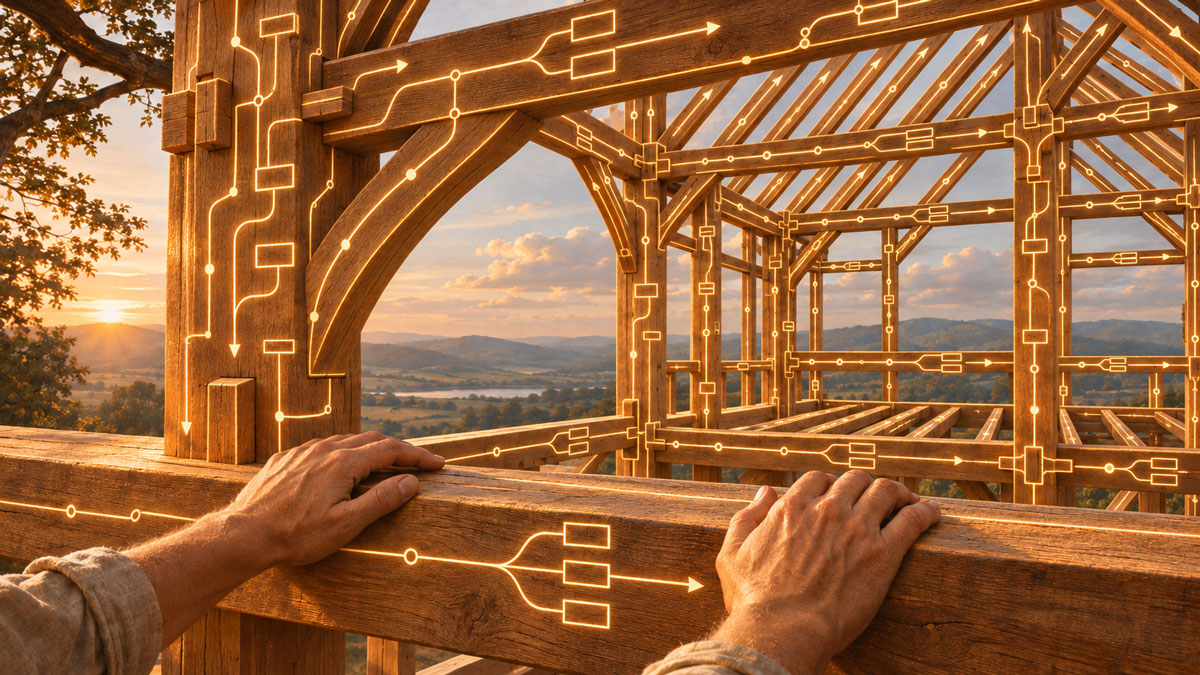
When you build a house with your own hands, you don’t need the blueprints to know where every pipe is. You can go months without stepping inside, and still, the day something breaks at 3 a.m., your body already knows which wall to touch. That’s different from inheriting a house someone else built: there you do need the blueprint, because you never lived the moment they decided to put that pipe right there and not a meter over.
We built this house. That’s why, even though I hadn’t visited it in months, I trusted my body would know which wall to touch.
The Foundations
Two years ago, a client came to us to solve something specific: their stores needed to run on Shopify POS. The rest of the team already knew Shopify, we’d used it for e-commerce many times. I, personally, had never touched Shopify POS. And in hindsight, the team hadn’t taken it this far before either: we knew it for selling online, not for running a physical point of sale with all the complexity that would require.
Setting up products, variants and SKUs, structuring prices and promotions: we already knew how to do that, it was familiar ground from our e-commerce projects. What wasn’t in any manual was what came next: connecting that catalog to the client’s real operation, with SAP S/4HANA living on the other side through BTP, SAP’s platform. Not one connection, but four distinct doors, each solving a different stage of what happens to a product: when it’s ordered, when it arrives, when it turns into something sellable, and when it finally sells. We built that ourselves, door by door, with no recipe to copy.
The Training
Two years later, the same client asked us for a training session for their operations team. They wanted to understand all four blocks: how to set up a product, how a production order works, what to do when something doesn’t sync between Shopify and BTP, how to pull a sales report to reconcile.
Running these integrations wasn’t part of their day-to-day; that stays outside what they operate daily. But knowing the full process, from when a product is ordered to when it’s sold, even though most of that path happens out of their sight, is what lets them notice when something doesn’t add up before it becomes a problem.
I knew exactly which topics they wanted to see. What I didn’t do was sit down and review the configuration line by line, as if I were seeing it for the first time. We were still supporting them, so it wasn’t unfamiliar territory, but it also wasn’t something I had fresh every day.
And that’s where the nerves came from: standing in front of their team, trusting that muscle memory, not recent memory, would answer.
It did. The questions came in and the answers came out before I’d even finished forming them in my head, as if someone else, two years younger, had left them there waiting for this exact moment. I didn’t have to stop and reconstruct anything: I knew why something was getting blocked, I knew what we could see on our side and what stayed, by design, on the other side of the border between our systems and theirs.
Those answers weren’t on any slide. They were in us, because we were the ones who decided, two years ago, where to put every pipe.
What This Means to Us
We don’t treat our builds as projects you deliver and forget. We treat them as pieces of our own history, things we built that keep teaching us even months after the last commit. That’s why we can walk into a training session without rehearsing it: not because we have a good memory, but because we know the whole operation, from the store floor to SAP, because we built it start to finish and we’re still there when something moves.
That same passion for understanding the full operation is why, with every new client, we start with a discovery phase before writing a single line of code. It’s not a formality or a box to check: it’s where the difference is born between building an integration that works on paper and building one that someone, two years later, can explain without reviewing anything the night before.
That’s what truly sets one team apart from another. Anyone can learn a manual the night before. Very few can walk through a system they built two years ago and still know, without thinking, where every wall is.
Tools change. What doesn’t change is that someone has to have built the house with their own hands to be able to explain it without a blueprint. If you have a system that’s growing, connecting to others, that needs someone who truly understands it and not just maintains it, you’ll find us at inflexionsoftware.com.